
Volumes 11 & 12
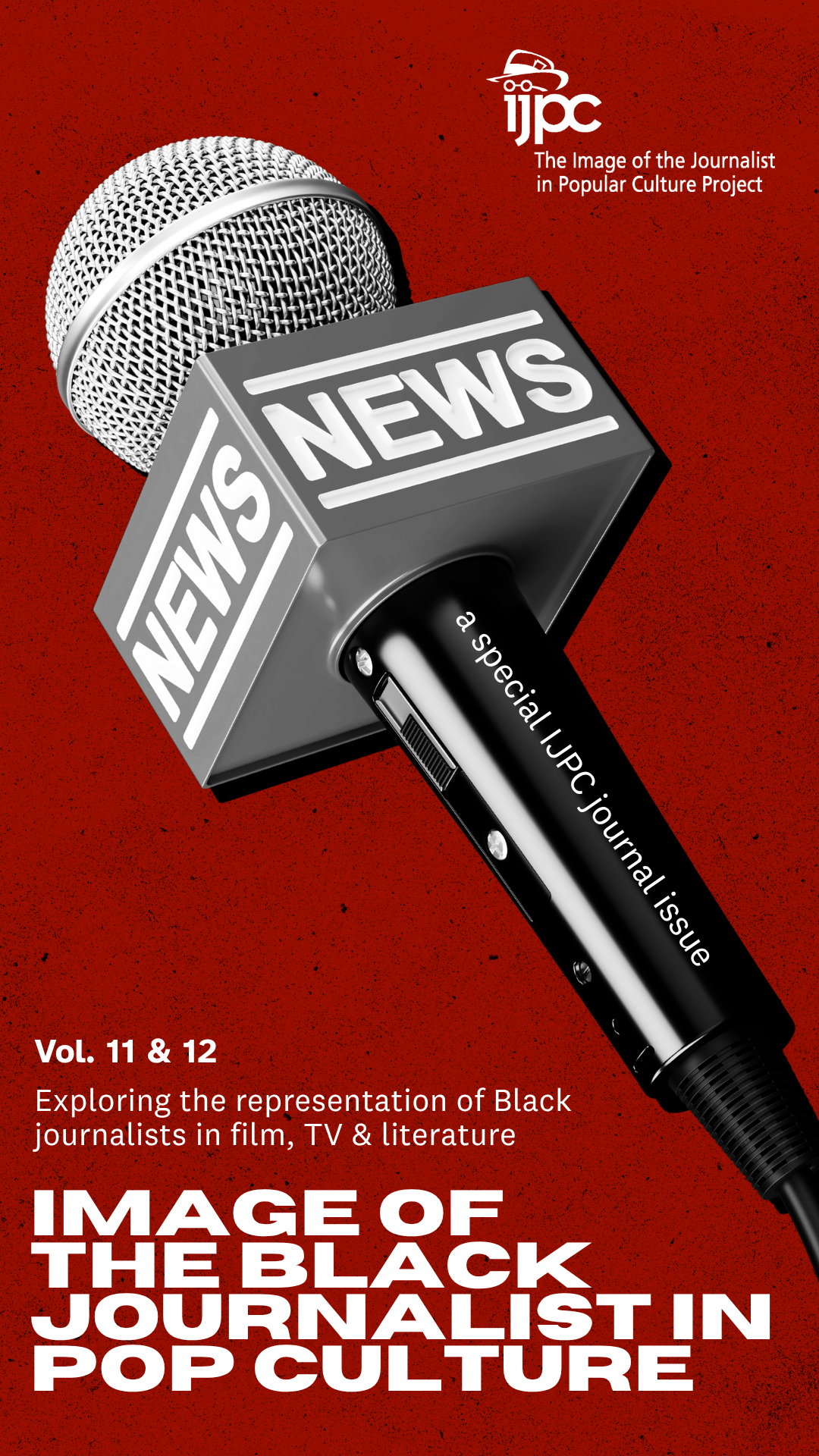
There is virtually no research when it comes to the image of the Black journalist in popular culture. In a special Image of the Journalist in Popular Culture (IJPC) Journal section – The Image of the Black Journalist in Popular Culture – we offer the first attempt to analyze what that image is in film, television and novels through academic and professional perspectives. The special section appears in Volumes 11 and 12, Fall 2023 to Spring 2026.
IJPC Journal Editors Laura Castañeda, Richard R. Ness and Joe Saltzman said the first five articles deal with the image of the Black journalist in film. We hope to publish more articles in the coming months for this special section on “The Image of the Black Journalist in Popular Culture.” Other articles about the image of the Black journalist in novels, television and other aspects of popular culture are currently being written by scholars across the country.
Christina L. Myers, an assistant professor at Michigan State University, goes back to the origin of film to write about “Countering the Frame: Black Journalists and the Politics of Representation in Silent Film.” Journalist Susan Smith Richardson takes a close look at “Committing Journalism While Black: Colorblind Casting and the Portrayal of Black Journalists.” Miki Turner, a professor of professional practices at the University of Southern California, explains that the plight of the Black journalist in movies has been “spot on in some cases, particularly in the two films – Livin’ Large! and Heat Wave – discussed” in “When Hollywood Gets It Right.” Journalist Regina Maria de Sousa Dias Soares from Brazil offers the first study of “The Image of the Black Journalist in Brazilian Popular Culture.” Omega Douglas Head of Journalism and Strategic Communications of Goldsmiths College, University of London, argues in “The Image of Black Western Journalists in Novels: Fact or Fiction?” that fictionalized accounts of Black women journalists, written by Black women authors who have lived experience of the British and US journalistic fields, offer important insight into frequently overlooked perspectives. In doing so, this paper centers the importance of popular culture to challenge power in ways ‘mainstream’ Western news outlets are largely failing to do.
In addition, Volumes 11 and 12 also feature two peer-reviewed articles whose objectives are to fill in strategic gaps in the study of the image of the journalist in popular culture. Patrick Ferrucci, chair and professor of journalism at the University of Colorado-Boulder, offers a “theoretical model for understanding journalism in film.” Darren Chan and Alexis Haskell from Temple University find in their article, “Newspeople of the world: a transnational comparison of fictional newsrooms and female journalists in drama between Taiwan and the United States,” that current research of fictional journalists in visual media has a blind spot: they tend to oversample American media, which produces insights applicable to only one national context.
My Approach
What began as a passion project has evolved into something more. We’re proud of where we’ve been and even more excited for what’s ahead. What sets us apart isn’t just our process—it’s the intention behind it. We take time to understand, explore, and create with purpose at every turn.
Simple ideas
Through every step, we've focused on staying true to our values and making space for thoughtful, lasting work.
Lasting impact
We build with clarity, act with integrity, and always stay curious.